Module 3 – Planning Low-Tech PBR
Below you’ll find the videos and PDFs from this module, licensed under Creative Commons, free to re-use under its terms.
🎥 Module 3 Video Playlist
Watch the entire playlist on YouTube:
Module 3 Playlist
Topics
A. Logistics, Learning Objectives & Introductions

Slides (PDF)
B. Overview of Planning & NRCS Conservation Planning Process

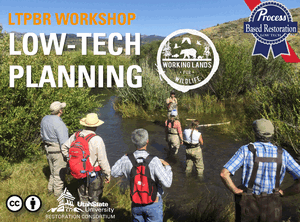
Slides (PDF)
C. Valley Bottom Mapping & Virtual Field Trip
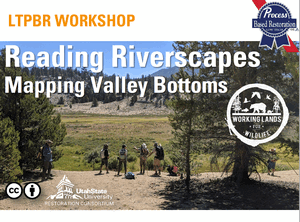
Slides (PDF)
VBET – Valley Bottom Extraction Tool
The valley bottom is the entry point to understanding a riverscape. A quick overview is in this 6-minute video:
Watch on YouTube
Exercise
Virtual Field Trip
We’ve also prepared a virtual field trip to Spawn Creek:
→ Reading Riverscapes Virtual Field Trip
🎤 Panel Discussion
D. Recognizing Structural Forcing in Riverscapes

Slides (PDF)
Join the virtual field trip for deeper exploration.
Wood in Riverscapes: Insights from the Headwaters
In 2026, we invited Ellen Wohl to elaborate on the scope of degradation in riverscapes (she refers to as river corridors) and the biophysical template needed for resilience. Watch her lecture below:
Some of Ellen's relevant work referred to in her lecture:
- Wohl, E., 2011. Threshold-induced complex behavior of wood in mountain streams. Geology 39, 587–590. DOI: 10.1130/g32105.1
- Wohl, E., 2014. A legacy of absence: wood removal in US rivers. Progress in Physical Geography: Earth and Environment 38, 637–663. DOI: 10.1177/0309133314548091
- Wohl, E., 2011. What should these rivers look like? Historical range of variability and human impacts in the Colorado Front Range, USA. Earth Surf. Process. Landf. 36, 1378–1390. DOI: 10.1002/esp.2180
- Pfeiffer, A., Wohl, E., 2018. Where Does Wood Most Effectively Enhance Storage? Network-Scale Distribution of Sediment and Organic Matter Stored by Instream Wood. Geophysical Research Letters 45, 194–200. DOI: 10.1002/2017GL076057
- Wohl, E., Inamdar, S., 2025. Beaver Versus Human: The Big Differences in Small Dams. WIREs Water. DOI: 10.1002/wat2.70019
- Wohl, E., Kramer, N., Ruiz-Villanueva, V., Scott, D.N., Comiti, F., Gurnell, A.M., Piegay, H., Lininger, K.B., Jaeger, K.L., Walters, D.M., Fausch, K.D., 2019a. The Natural Wood Regime in Rivers. BioScience 69, 259–273. https://doi.org/10.1093/biosci/biz013
- Wohl, E., Scamardo, J.E., 2021. The resilience of logjams to floods. Hydrological Processes 35, e13970. DOI: 10.1002/hyp.13970
- Wohl, E., Uno, H., Dunn, S.B., Kemper, J.T., Marshall, A., Means-Brous, M., Scamardo, J.E., Triantafillou, S.P., 2023. Why wood should move in rivers. River Research and Applications n/a. DOIL 10.1002/rra.4114
Did you know, even as professional registered for the CEWA course, you can use your USU access credentials and login (the same you use for Canvas) to get full access to USU's journal subscriptions? This includes access to Wiley, Taylor & Francis, Springer, and more. Just log in through the USU library portal or visit any of the above links and you should be prompted to login with your USU credentials.
🎤 Panel Discussion
E. Risk Assessment, Condition Assessment, & Recovery Potential
Slides (PDF)
RCAT – Riparian Condition Assessment Tool
Learn about RCAT in this quick overview video:
Watch on YouTube
BRAT – Beaver Restoration Assessment Tool
A short overview of BRAT, exploring its role in planning:
Watch on YouTube
Exercise
🎤 Panel Discussion
F. Connecting & Clarifying Objectives & Tying to Goals

Slides (PDF)
G. Module 3 Synthesis