Implementation of LTPBR - Course Syllabus


Take me to Canvas
I'm enrolled. Take me right to 2026 Canvas Course for WATS/CEWA 5624 - Implementation of LTPBR (Requires registration).

Take me to Lectures & Modules
The modules associated with WATS/CEWA 5624 - Implementation of LTPBR are free for viewing here.
Most of the content for this course is free and available to everyone. However, registration is required to access the Canvas course where assignments will be submitted and graded. If you register as a Continuing Education particpant, see here for how to access your account and Canvas.
Catalog Description
This course introduces Low-Tech Process-Based Restoration of Riverscapes implementation. Students will construct low-tech structures like PALS (post-assisted log structures) and BDAs (beaver dam analogues) on student-designed restoration projects. Students will also explore consultation, permitting, construction safety, and logistics.
| Title | Implementation of Low-Tech Process-Based Restoration of Riverscapes |
|---|---|
| Course Number | WATS 5624 |
| Semester Offered | Spring |
| Credits | 1.0 Credit (1.5 CEU) |
| Levels | Graduate / Undergraduate |
| Schedule | Online Lecture / In-Person Field Trip |
| Cross-listed | CEWA 5624 |
Schedule
Spring 2026 - Implementation of LTPBR
- Matriculated Students: WATS 5624 Register via Banner
- Non-USU / Professional Students: CEWA 5624 Registration
Registration opens November 10, 2025.
| Class | Time | Days | Location | Dates | Instructor |
|---|---|---|---|---|---|
| Implementing LTPBR | 1:30–4:15 pm | Tuesday | via Zoom | Apr 7, 2026 | Joe Wheaton |
| Implementing LTPBR | 8:00 am–5:00 pm | Saturday | Field Trip | Apr 18, 2026 | Joe Wheaton |
Course assignments and materials will be posted in Canvas two weeks prior to the first class.
Course Outline
| Date | Modules | Topics |
|---|---|---|
| 4/7/2026 | 5.2–5.5 | Overview, Consultation & Permitting, Logistics, Equipment & Safety, Construction of PALS & BDAs |
| 4/18/2026 | 5.6 | Field Day (Saturday): Constructing an LTPBR Project |
Mandatory attendance is expected for both the lecture and field trip.
Module 5 - Implementation Materials (slides, videos, exercises)
Fees
-
Matriculated Students: standard USU tuition rates plus a $100 course fee for field trip materials and equipment.
-
Continuing Education Students: $420 for 1.5 CEUs
(includes $45 CEU processing fee)
Course Objectives
By the end of this course, students will:
- Understand the consultation and permitting process
- Apply low-tech construction techniques safely
- Create an adaptive management plan including maintenance and next-phase considerations
- Document as-built conditions
Instructor

Joe’s Office Hours: Monday 13:00–14:00 MT on Google Meet
To contact your instructor, please use Canvas discussion boards or direct messaging.
Instructor Affiliations


Course Resources
You can capture an as-built of your construction very Fast
Using QRiS, you can get yourself from nothing to an as-built very fast as I show you in the video below. With as-builts, we are simply capturing what was built. You can compare with a Design data capture event in QRiS, but this is not necessary. As-builts become the basis for indivdual reporting of projects in the PBR Explorer!

QRiS - As-Built Protocols
Riverscape Studio has As-Built Protocols for capturing implementation efforts. You will do this as part of the projects you build.

PBR Explorer
The Process-Based Restoration Explorer is a Riverscapes Consortium hosted community for sharing about your PBR efforts and actions. Think of it like Strava for PBR.
Content

Chapter 6 LT-PBR Manual
Chapter 6 of LTPBR Design Manual is on Implementation

Module 5 Self-Paced Modules
These are the pre-recroded lectures and readings for Module 5
Course Textbooks
LT-PBR Manual
The 2019 Low-Tech Process-Based Restoration of Riverscapes Design Manual (Free/Required). Focus on Chapter 5 & 6 of the Design Manual.
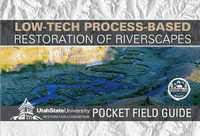
Pocket Guide
A LTPBR Pocket Guide to take with you into the field (Optional)
Focus on Chapters 4 and 6 of the Design Manual.
Grading
Points will be awarded based on quizzes and assignments, with rubrics posted in Canvas.
| Grade | Range |
|---|---|
| A | 93–100% |
| A- | 90–92.9% |
| B+ | 87–89.9% |
| B | 83–86.9% |
| B- | 80–82.9% |
| C+ | 77–79.9% |
| C | 73–76.9% |
| C- | 70–72.9% |
| D+ | 67–69.9% |
| D | 60–66.9% |
| F | below 60% |
Attendance Policy
Attendance is required for all class meetings and the field day. Please see USU attendance policies.
University Policies
USU’s policies on:
- Academic Integrity
- Student Code
- Disability Resource Center
- Library Services
- Mental Health Resources
- Title IX & Equity
- Emergency Procedures
apply to this course. Please review them as part of your academic responsibilities.