Designing LTPBR - Course Syllabus


Take me to Canvas
I'm enrolled. Take me right to 2026 Canvas Course for WATS/CEWA 5623 - Designing LTPBR (Requires registration).

Take me to Lectures & Modules
The modules associated with WATS/CEWA 5623 - Designing LTPBR are free for viewing here.
Most of the content for this course is free and available to everyone. However, registration is required to access the Canvas course where assignments will be submitted and graded. If you register as a Continuing Education particpant, see here for how to access your account and Canvas.
Catalog Description
This course provides an introduction to designing Low-Tech Process-Based Restoration of Riverscapes. Students will design their own LTPBR restoration projects at a site of their choosing.
| Title | Design of Low-Tech Process-Based Restoration of Riverscapes |
|---|---|
| Course Number | WATS 5623 |
| Semester Offered | Spring |
| Credits | 1.0 credit (1.5 CEU) |
| Levels | Graduate / Undergraduate |
| Schedule | Online Lecture |
| Cross-listed | CEWA 5623 |
Schedule
Spring 2026 - Designing LTPBR
- Matriculated USU Students: WATS 5623 Register via Banner
- Non-USU / Professional Students: CEWA 5623 Registration
(Registration opens November 10, 2025)
| Class | Time | Days | Dates | Instructor |
|---|---|---|---|---|
| Designing LTPBR | 1:30–4:15 pm | Tuesdays | Mar 17, 24, & 31, 2026 | Joe Wheaton |

Join by Zoom
Meeting ID: 851 1572 0965; Passcode: 846967
Course materials and assignments will be available on Canvas the week before the course starts.
Students are expected to watch pre-recorded lectures and complete readings before discussion sessions.
Discussion Session Schedule:
| Meeting Date | Modules | Topics |
|---|---|---|
| 3/17/2026 | 4.1 | Intro to Design Process; Leading Design with Recovery Potential |
| 3/24/2026 | 4.2 | Design Standards of Practice @ Complex-Scale; Learning to Design @ Structure-Scale |
| 3/31/2026 | 4.3 | Field Design Documentation; Designing at Your Own Riverscape |
This course is based on Module 4 of the self-paced materials.
Fees
-
Matriculated Students: current USU tuition rates for 1 credit (no additional course fee)
-
Continuing Education Students: $320 (Includes $45 CEU processing fee)
Course Objectives
By the end of this course, students will:
- Develop familiarity with the core components of the LTPBR design process.
- Understand the difference between engineering-based and LTPBR design processes.
- Create a complete low-tech PBR field design for a first phase of restoration in an impaired riverscape.
- Learn how to use a zone of influence to convey hypotheses associated with structural forcing.
- Assess the degree of uplift for a design phase and estimate the timeline to achieve full recovery potential.
Instructor

Joe’s Office Hours: Monday 13:00–14:00 MT on Google Meet
To contact your instructor, please use Canvas discussion boards or direct messaging.
Course Resources
You can Design very Fast
Using QRiS, you can get yourself from nothing to a design very fast as I show you in the video below. But why are you specifying what to put where the way you are? What are you trying to accomplish? Hopefully you find the video reassuring in that you can do the mechanics of design, but unsatisfying for addressing your curosities about why. That is hoepfully motivation for taking this class.
Content
Chapter 4 LT-PBR Manual
Chapter 4 of LTPBR Design Manual is on PALS and BDAs
Chapter 5 LT-PBR Manual
Chapter 5 of LTPBR Design Manual covers Design

Module 4 Self-Paced Modules
These are the pre-recroded lectures and readings for Module 4
Course Textbooks
LT-PBR Manual
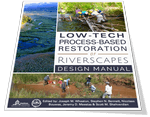
The 2019 Low-Tech Process-Based Restoration of Riverscapes Design Manual (Free/Required). Focus on Chapter 4 & 5 of the Design Manual.
Pocket Guide
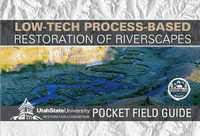
A LTPBR Pocket Guide to take with you into the field (Optional)
Focus on Chapters 4 and 5 of the Design Manual.
Grading
| Grade | Range |
|---|---|
| A | 93–100% |
| A- | 90–92.9% |
| B+ | 87–89.9% |
| B | 83–86.9% |
| B- | 80–82.9% |
| C+ | 77–79.9% |
| C | 73–76.9% |
| C- | 70–72.9% |
| D+ | 67–69.9% |
| D | 60–66.9% |
| F | below 60% |
Points are awarded for quizzes and assessed assignments as posted on Canvas.
University Policies
See Canvas for University Policies.