Intro to LTPBR - Course Syllabus

Take me to Canvas
I'm enrolled. Take me right to 2026 Canvas Course for WATS/CEWA 5620 - Intro to LTPBR (Requires registration).

Take me to Lectures & Modules
The modules associated with WATS/CEWA 5620 - Intro to LTPBR are free for viewing here.
Most of the content for this course is free and available to everyone. However, registration is required to access the Canvas course where assignments will be submitted and graded. If you register as a Continuing Education particpant, see here for how to access your account and Canvas.
Catalog Description
This course provides an introduction to the practice of Low-Tech Process-Based Restoration (LTPBR) of riverscapes. Students will learn about riverscape degradation, examples of low-tech restoration, and core restoration principles.
| Title | Introduction to Low-Tech Process-Based Restoration of Riverscapes |
|---|---|
| Course Number | WATS 5620 |
| Semester Offered | Spring |
| Credits | 1.0 Credit (1.5 CEU) |
| Level | Graduate / Undergraduate |
| Schedule | Online Lecture |
| Cross-listed | CEWA 5620 |
Schedule
Spring 2026 - Intro to LTPBR
- Matriculated USU Students: WATS 5620 Register via Banner
- Continuing Ed/Professional Students: CEWA 5620 Registration
Registration opens November 10, 2025.
| Class | Time | Days | Location | Dates | Instructor |
|---|---|---|---|---|---|
| Intro to LTPBR | 1:30–4:15 pm | Tuesdays | Zoom | Jan 6, 13, 20 2026 | Joe Wheaton |
Topic: Intro LTPBR Class - Spring 2026 WATS-5620 Time: Jan 6, 2026 01:30 PM Mountain Time (US and Canada) Every week on Tue, 3 occurrence(s)

Join by Zoom
Meeting ID: 890 3073 9398; Passcode: 252274
Course Schedule & Topics
| Date | Module | Topics |
|---|---|---|
| Jan 6, 2026 | 1.1 | Background & Scope of Degradation, Build Your First BDA |
| Jan 13, 2026 | 1.2 | Intro to Low-Tech Tools, Guiding Principles |
| Jan 20, 2026 | 1.3 | Partnering with Beaver, Synthesis |
Access Module 1 Resources (slides, videos, exercises)
January 6 Specific resources
Introductions & Riverscapes Consortium Overview
What is a Riverscape?
For you to ponder:
- How is a riverscape different than a river corridor as Ellen defines it?
- How is a riverscape different than a river or stream?
- How is a riverscape different than a watershed or landscape?
Details
References See also:
- Fausch, K.D., Torgersen, C.E., Baxter, C.V., Li, H.W., 2002. Landscapes to riverscapes: Bridging the gap between research and conservation of stream fishes. Bioscience 52, 483–498. DOI: 10.1641/0006-3568(2002)052%255B0483
- Skidmore, P., Wheaton, J., 2022. Riverscapes as natural infrastructure: Meeting challenges of climate adaptation and ecosystem restoration. Anthropocene 38, 100334. DOI: 10.1016/j.ancene.2022.100334
- Torgersen, C.E., Le Pichon, C., Fullerton, A.H., Dugdale, S.J., Duda, J.J., Giovannini, F., Tales, É., Belliard, J., Branco, P., Bergeron, N.E., Roy, M.L., Tonolla, D., Lamouroux, N., Capra, H., Baxter, C.V., 2021. Riverscape approaches in practice: perspectives and applications. Biological Reviews 97, 481–504. DOI: 10.1111/brv.12810
- Glassic, H.C., Al-Chokhachy, R., Wheaton, J., Macfarlane, W.W., Jordan, C.E., Murphy, B., Shahverdian, S., Bennett, S., Bouwes, N., Fryirs, K., Brierley, G., Ciotti, D., Bailey, P., Bartelt, K., Belletti, B., Bizzi, S., Brasington, J., Camp, R., Fairfax, E., Gilbert, J., Jimenez, J., Maestas, J., Mandish, T., McNamara, A., Miller, S., Morizot, B., Perle, M., Piégay, H., Reid, H., Reynolds, L.V., Saunders, W.C., Shallcross, A., Skidmore, P., Smith, R., Terrier, B., Wathen, G., Weber, N., 2025. Principles of Riverscape Health. WIREs Water 12, e70028. DOI: 10.1002/wat2.70028
Fees
-
Matriculated Students: pay standard USU tuition.
-
Continuing Education Students: $320 (includes $45 CEU processing fee).
Course Objectives
By the end of this course, students will be able to:
- Understand the scope of riverscape degradation.
- Identify a vision for what healthy riverscapes could look like.
- Recognize various low-tech treatments and practices.
- Apply Principles of Riverscape Health for condition assessment.
- Distinguish LTPBR principles from traditional restoration.
- Articulate why and where beaver activity supports LTPBR.
Instructors

Joe’s Office Hours: Monday 13:00–14:00 MT on Google Meet
Course Resources
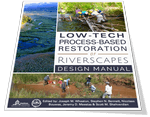
Chapter 1 LT-PBR Manual
Chapter 1 of LTPBR Design Manual is an Introduction
Chapter 2 LT-PBR Manual
Chapter 2 of LTPBR Design Manual covers Principles
Chapter 7 LT-PBR Manual
Chapter 7 of LTPBR Design Manual is a Call to Action

Module 1 Self-Paced Modules
These are the pre-recroded lectures and readings for Module 1
Required Textbooks
LT-PBR Manual
The 2019 Low-Tech Process-Based Restoration of Riverscapes Design Manual (Free/Required). Focus on Chapter 3 of the Design Manual.
Pocket Guide
A LTPBR Pocket Guide to take with you into the field (Optional)
Focus on Chapters 1, 2, and 7 of the Design Manual.
Community Resources
These communities from the Riverscapes Consortium are great places to ask questions, connect with colleagues and share your work.

LTPBR of Riverscapes - Short Course Series Community
The community for connecting with others in this class and the series of Introduction to LTPBR courses. This is in lieu of Canvas.
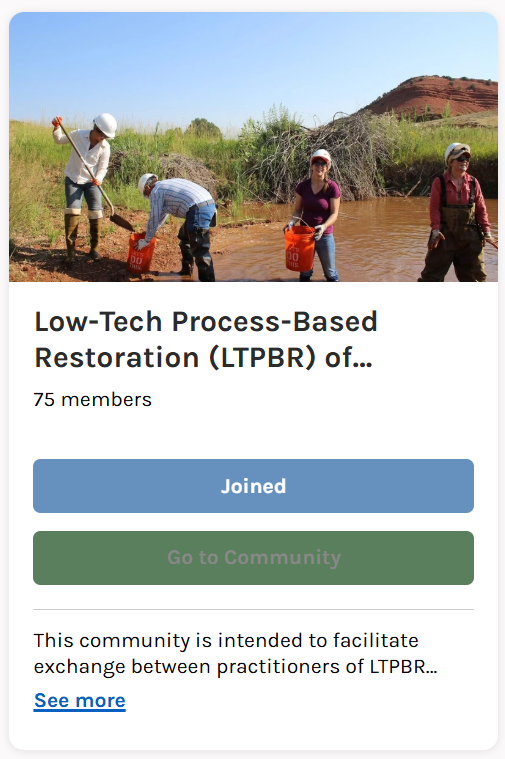

LTPBR of Riverscapes - Practitioner Community
This community is intended to facilitate exchange between practitioners of LTPBR anywhere in the world.
Course Grading
Points will be awarded for quizzes and exercises as listed in Canvas. Rubrics will be provided.
| Grade | Range |
|---|---|
| A | 93–100% |
| A- | 90–92.9% |
| B+ | 87–89.9% |
| B | 83–86.9% |
| B- | 80–82.9% |
| C+ | 77–79.9% |
| C | 73–76.9% |
| C- | 70–72.9% |
| D+ | 67–69.9% |
| D | 60–66.9% |
| F | below 60% |
University Policies
USU policies apply, including:
- Attendance
- Academic Integrity
- Student Code
- Library Services
- Disability Resource Center
- Counseling & Mental Health
- Title IX & Equity
If you experience barriers or need accommodations, please reach out to the instructor or DRC as early as possible.